A Plain-Language Look at the Real Lives Behind the Bible
Before we get into what the Bible says or what people believed back then, we have to stop and ask a simple question:
Who were the people the Old Testament was written for?
Not just their names — but what kind of lives they lived, where they lived, how they thought about themselves, and what kind of world they were part of.
Because the Old Testament wasn’t written to us.
It was written for real people, thousands of years ago, living in a very different time, in a very different place. And if we want to understand what the Bible meant to them, we need to start by understanding who they were.
Where They Lived
The people the Old Testament was written for lived in a region called Canaan — land that today includes:
- Israel
- Palestine
- Western Jordan
- Southern Lebanon
Canaan was in the middle of everything — sitting between powerful empires like Egypt to the south and Babylon/Assyria to the northeast. That made it an important piece of land, but also a dangerous one. Big empires often fought over it.
By around 1200 to 1000 BCE, when the earliest parts of the Bible began to take shape, Canaan was going through a big change. Egypt was losing control. Cities were falling apart. And in the hills, small tribal groups began settling into new villages.
One of those groups would eventually be called Israel.
How They Lived
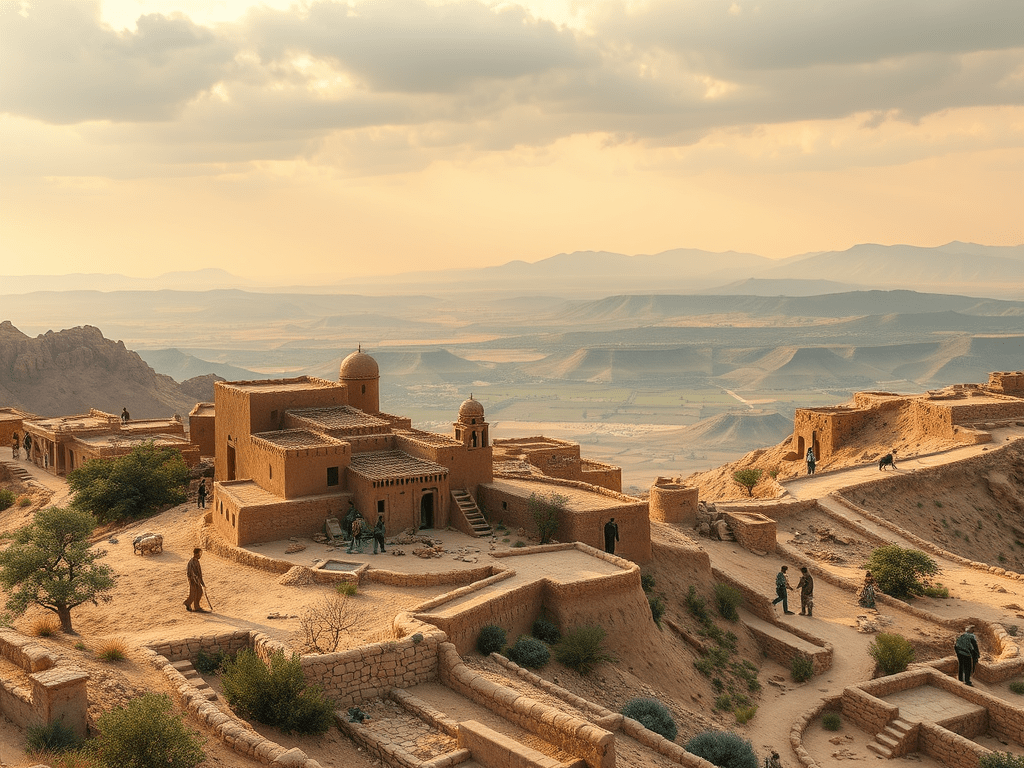
These early Israelites weren’t kings or warriors. Most of them were farmers, shepherds, and laborers. They lived in small hilltop villages with simple homes made from mud and stone.
A typical family:
- Worked the land
- Grew grain or olives
- Raised sheep or goats
- Lived with several generations under one roof
They didn’t have schools or books. Most people couldn’t read or write. Information and stories were passed down by word of mouth — told at home, in the fields, or at community gatherings.
They lived in tight-knit clans — big family groups that worked together and shared resources. Life was local. Your tribe or village was your whole world.
They Were Canaanites — Not Outsiders
Now here’s something most people don’t realize:
The Israelites weren’t a totally new group that moved in from somewhere else.
They were part of the same people already living in the land.
They were Canaanites.
When we look at the archaeological record — what’s left behind in the ground — we don’t see a big invasion or takeover. We see:
- The same types of houses
- The same kind of pottery
- The same farming tools
- The same layout of villages
In fact, the earliest group we can call “Israel” just looks like a rural branch of Canaanite society that began forming its own identity. They weren’t new. They were local people, organizing in a new way, telling new stories about themselves.
So when we ask, who was the Old Testament written for?
The answer is: Canaanites, living in small farming villages, starting to think of themselves as “Israel.”
What We Know from Archaeology
Archaeologists have found plenty of clues about these people by digging at ancient sites:
- In the highlands of Canaan, new villages appear around 1200 BCE — where older city life had faded
- These villages used simple, everyday tools
- They had family-centered homes, with space for animals and food storage
- Some used special clay jars and four-room houses that show up in both Canaanite and early Israelite places
One famous discovery is the Merneptah Stele — a stone monument from Egypt around 1208 BCE. It’s the first time the name “Israel” appears in history. But it doesn’t call Israel a country or a city. It just calls it a group of people living in Canaan.
That matches everything else we know: early Israel wasn’t a nation yet — just a collection of tribes in the hills.
What Language They Spoke
The people who became Israel spoke a version of the Canaanite language, called early Hebrew.
It wasn’t completely unique at first. It was just one dialect among many.
This early Hebrew came from the same roots as the language spoken in nearby cities like Tyre, Ugarit, and Sidon. Over time, it developed its own style, especially once scribes began writing laws, poetry, and history — what we now call the Bible.
They also used a very early alphabet, one of the first of its kind, making it easier to pass down stories in writing once that became more common.
They Were Community People
Their world was built around:
- Family
- Land
- Tradition
Each village was a kind of extended family — everyone knew everyone, and survival depended on working together. These people were close to the land, close to each other, and constantly negotiating how to stay alive in a harsh and changing world.
There were no kings over them at first. Just elders, clan leaders, and traveling storytellers or prophets. That’s the world reflected in early biblical books like Judges — local leadership, village justice, and people figuring things out together.
So Who Were These People?
Let’s bring it all together.
The people the Old Testament was originally written for:
- Lived in the hill country of ancient Canaan
- Were not foreigners, but part of the Canaanite population
- Were mostly farmers, shepherds, and families
- Spoke a form of Canaanite, which became early Hebrew
- Lived in clan-based villages
- Shared tools, houses, and customs with their Canaanite neighbors
- Only gradually developed a distinct “Israelite” identity
They weren’t a separate race. They weren’t invaders.
They were ordinary people — slowly becoming something new.
A Note From Me…
I’m not a scholar — I’m just someone trying to understand the Bible from the ground up. What I’ve shared here is based on what historians and archaeologists have found so far. I might not have it all exactly right — but I’m learning, and I’m sharing what I learn as I go.
Absolutely! Below is a list of common scholarly sources that support the information in your post — all from non-Christian, historical-critical, or archaeologically grounded perspectives. These are respected in the field and widely cited in academic circles. Most are accessible to serious readers (some are even beginner-friendly).
Common Scholarly Sources on Early Israelite Identity & Canaanite Origins:
1. Israel Finkelstein & Neil Asher Silberman
📘 Book: The Bible Unearthed: Archaeology’s New Vision of Ancient Israel and the Origin of Its Sacred Texts
Why it matters: This is one of the foundational texts arguing that early Israelites were native Canaanites, not foreign invaders. Finkelstein is an archaeologist; Silberman a historian and writer.
2. William G. Dever
📘 Books:
- Who Were the Early Israelites and Where Did They Come From?
- Did God Have a Wife?: Archaeology and Folk Religion in Ancient Israel
Why it matters: Dever is a leading archaeologist in the field of ancient Israel. He argues from evidence found in rural sites and shrines that Israelite religion and identity developed from within Canaanite society.
3. Mark S. Smith
📘 Books:
- The Early History of God: Yahweh and the Other Deities in Ancient Israel
- The Origins of Biblical Monotheism: Israel’s Polytheistic Background and the Ugaritic Texts
Why it matters: Smith is a religious studies scholar who works with both archaeology and ancient texts. He connects the dots between Israelite beliefs and the Canaanite pantheon, using sources like the Ugaritic texts.
4. Carol Meyers
📘 Book: Discovering Eve: Ancient Israelite Women in Context
Why it matters: Meyers focuses on daily life — especially for women — in early Israel. She draws from archaeological and anthropological sources to paint a realistic picture of small-village life.
5. K. L. Noll
📘 Book: Canaan and Israel in Antiquity: A Textbook on History and Religion
Why it matters: This is a balanced, academic textbook that walks through the history of Canaan and Israel without religious assumptions, covering both archaeological and textual data.
6. Philip R. Davies
📘 Book: In Search of “Ancient Israel”
Why it matters: Davies questions how much of biblical “Israel” existed before the texts were written. He emphasizes that early Israel was not a singular ethnic group, but a later identity constructed in part through writing.
7. Richard Elliott Friedman
📘 Book: Who Wrote the Bible?
Why it matters: While more focused on authorship and editing, Friedman’s work helps place biblical writing in its historical setting — including the rise of tribal groups in Canaan.
8. Lawrence E. Stager
📰 Article: “The Archaeology of the Family in Ancient Israel” (Biblical Archaeology Review, 1993)
Why it matters: Offers archaeological insight into household structure, community layout, and daily life.
🔍 Academic Databases and Open Access Journals:
If you want to explore more deeply:
- The Journal of Near Eastern Studies (JNES)
- The Journal of Biblical Literature (JBL)
- Biblical Archaeology Review (BAR) – accessible and semi-popular level
- ASOR (American Society of Overseas Research) – articles and dig reports
Bonus: Accessible Introductions
If you’re writing for a general audience and want to fact-check in plain language:
- Pete Enns – The Bible for Normal People (podcast, blog, books)
- Naked Bible Podcast (Michael Heiser, older episodes)
- Bart Ehrman’s blog – while more New Testament focused, he explains historical-critical methods well
 Sacred Scholar
Leave a comment