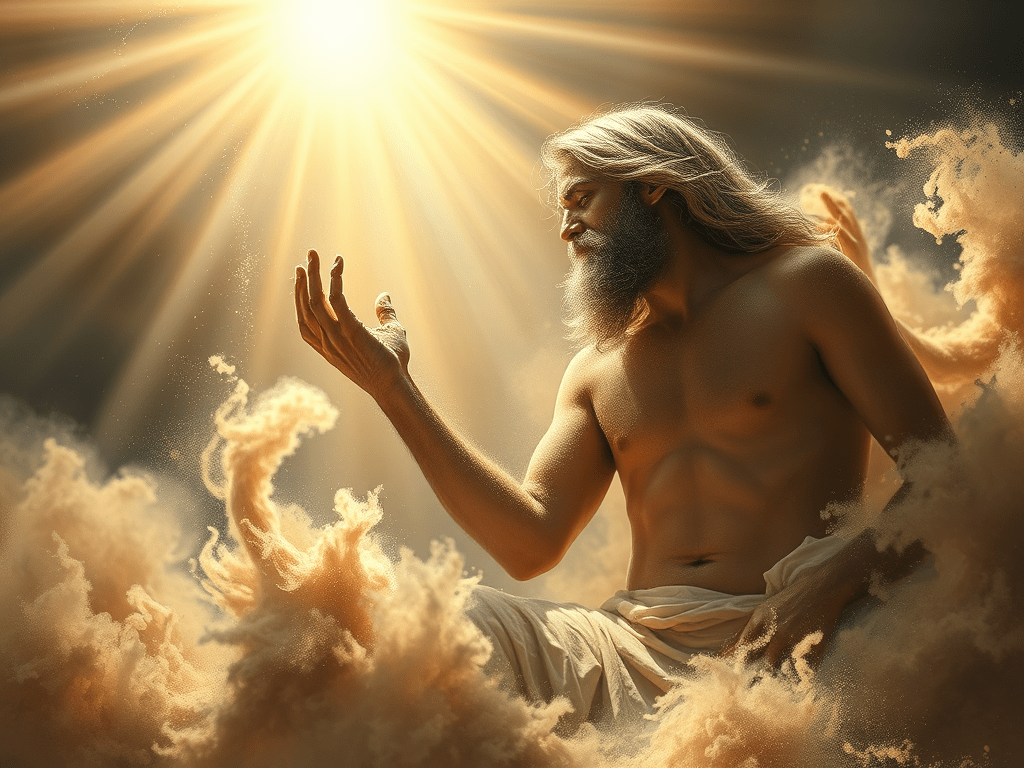
Humanity and Responsibility
Then God said, “Let us make mankind in our image, in our likeness, so that they may rule over the fish in the sea and the birds in the sky, over the livestock and all the wild animals, and over all the creatures that move along the ground.”
So God created mankind in his own image, in the image of God he created them; male and female he created them.
God blessed them and said to them, “Be fruitful and increase in number; fill the earth and subdue it. Rule over the fish in the sea and the birds in the sky and over every living creature that moves on the ground.”
(Genesis 1:26–28, NIV)
Summary
Day six reaches its height with the creation of humankind. For the first time, God speaks in the plural—“Let us make”—and humans are made in the “image” and “likeness” of God. They are tasked with ruling over all other living creatures and blessed with fertility and dominion. These verses mark a major theological and literary shift, setting humans apart not just in form, but in function and authority.
Historical & Cultural Background
“Let Us Make…” and Divine Councils
The plural language (“let us”) is best understood within the ancient Near Eastern concept of the divine council—a heavenly assembly of lesser beings or spirits under a chief deity. We see similar scenes in Ugaritic texts, Mesopotamian literature, and biblical passages like Psalm 82 and Job 1.
This use of “us” is not a reference to the Christian Trinity (a much later development), but a familiar literary device to ancient readers indicating divine deliberation or majestic formality.
The Image of God (Tzelem Elohim)
In surrounding cultures, kings were often said to be made in the image of a god. In contrast, Genesis democratizes this status: all humans reflect divine likeness. This was a radical theological claim in the ancient world—it challenged hierarchies, sacral kingship, and ethnic exclusivity.
Subdue and Rule
- “Subdue” (kavash) implies bringing something under control, but not destruction.
- “Rule” (radah) is royal language, but it can also denote pastoral oversight or stewardship.
This passage has been used (and misused) in debates on ecology, patriarchy, and colonialism. But the Hebrew terms suggest responsible management, not exploitation.
Hebrew Word Notes
| Hebrew Term | Translation | Significance |
|---|---|---|
| Tzelem (צֶלֶם) | Image | A visible representation or imprint; often used of statues or idols. |
| Demut (דְּמוּת) | Likeness | Similarity or resemblance—used to soften or qualify “image.” |
| Adam (אָדָם) | Humankind | Not just “man,” but collective humanity. Gender-neutral in context. |
| Zakar u’Neqevah (זָכָר וּנְקֵבָה) | Male and female | Both created in the image—equal bearers of divine likeness. |
| Radah (רָדָה) | To rule | Governing language, often used of kings or shepherds. |
| Kavash (כָּבַשׁ) | To subdue | Means to harness or cultivate, not to destroy. |
| Barach (בָּרַךְ) | Bless | First human-directed blessing in the text. |
Themes & Questions
1. Divine Image for All
Genesis challenges the elite power structures of its time by placing divine value in all people—regardless of sex, class, or role. This democratized vision is one of the boldest parts of the text.
2. Gender in the Creation Story
Both male and female are explicitly said to be created in the image of God. This short, powerful line resists any interpretation that limits divine likeness to one gender or social role.
3. Rule as Responsibility
Rather than domination, the commands to “rule” and “subdue” align with Genesis’ overall concern for order, fertility, and blessing. Humans are tasked with extending the goodness of creation—not conquering it.
4. Human Place in the Cosmos
Humanity is not the last step in creation by chance—it is the culmination. But that status comes with responsibility: to organize, fill, and govern wisely.
Related Posts
- Genesis 1, Part 1: From Chaos to Cosmos (Genesis 1:1–13)
- Genesis 1 Part 2 1:14–19 — Lights in the Vault: The Fourth Day of Creation
- Genesis 1 Part 3 1:20–23
- Genesis Part 4: 1:24–25
Further Reading (Refreshed & Topic-Specific)
- Richard Middleton, The Liberating Image: The Imago Dei in Genesis 1
- A deep, non-theological study of what it meant to be made in God’s image in the ancient world.
- Benjamin Sommer, The Bodies of God and the World of Ancient Israel
- Discusses the fluidity of divine embodiment and language in biblical texts.
- Phyllis Trible, God and the Rhetoric of Sexuality
- A literary-feminist approach to Genesis 1–3, focused on gender and creation.
- Mark S. Smith, The Origins of Biblical Monotheism
- Explores divine council language and how biblical authors reworked older traditions.
- Ilana Pardes, Countertraditions in the Bible
- Challenges dominant readings of Genesis, with attention to marginalized voices.
Disclaimer & Call to Action
This post is written from a scholarly, non-Christian perspective, aiming to help readers engage the Hebrew Bible in its ancient context. It’s not a sermon—it’s an exploration.
Enjoying this project? Share it, join the conversation, and explore more at Sacred Scholar. We’re building knowledge, one verse at a time.

 Sacred Scholar
Leave a comment