Full Passage (Genesis 2:19–25, NIV):
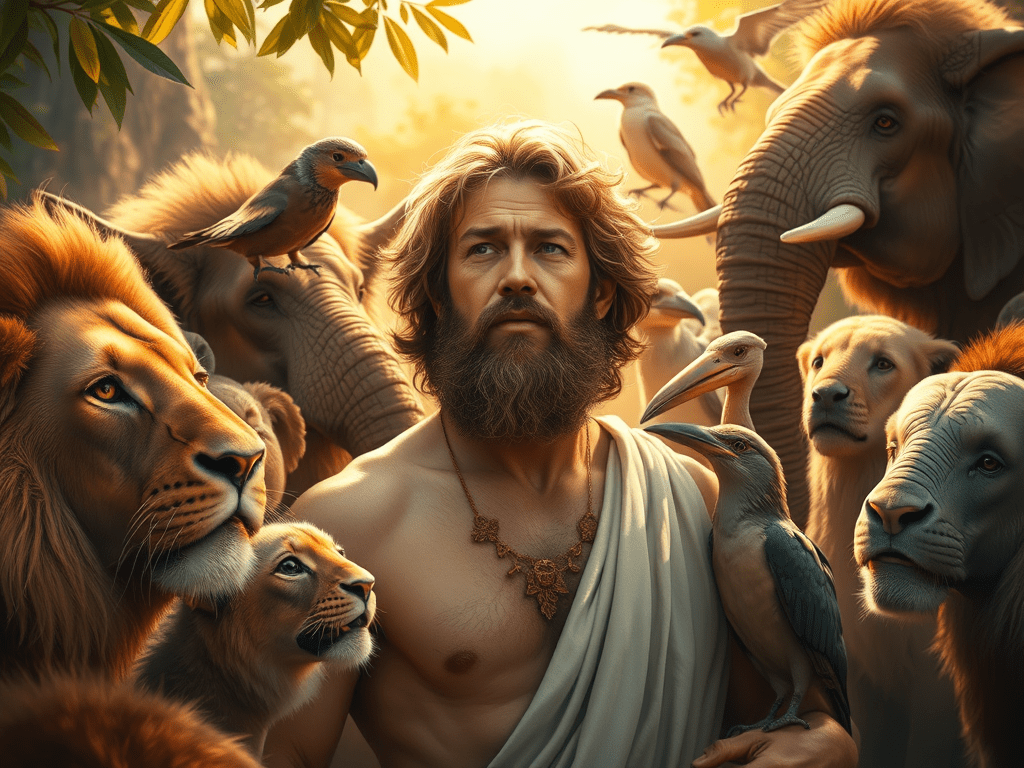
19 Now the Lord God had formed out of the ground all the wild animals and all the birds in the sky. He brought them to the man to see what he would name them; and whatever the man called each living creature, that was its name.
20 So the man gave names to all the livestock, the birds in the sky and all the wild animals.But for Adam no suitable helper was found.
21 So the Lord God caused the man to fall into a deep sleep; and while he was sleeping, he took one of the man’s ribs and then closed up the place with flesh.
22 Then the Lord God made a woman from the rib he had taken out of the man, and he brought her to the man.23 The man said,
“This is now bone of my bones
and flesh of my flesh;
she shall be called ‘woman,’
for she was taken out of man.”24 That is why a man leaves his father and mother and is united to his wife, and they become one flesh.
25 Adam and his wife were both naked, and they felt no shame.
Summary
This passage describes two major developments in the Genesis creation narrative: humanity’s role in naming the animals and the creation of woman as a partner to the man. After naming the animals, it becomes clear that none of them are a true counterpart to the man. God then creates woman from the man’s rib, and the man recognizes her as part of himself. The story closes with a declaration about marriage — leaving one’s family of origin to form a new union — and with an image of harmony and innocence: man and woman together without shame.
Historical and Cultural Background
The Naming of Animals
In the ancient Near East, naming was an act of power. To name something was to define its identity, establish one’s authority over it, or set the terms of relationship. Many Mesopotamian myths portray the gods as the ones who name things, but here in Genesis, that task is given to the human. This marks a distinctive role for humanity: the world is not only created but also entrusted to human care and classification.
The act of naming also highlights the search for companionship. As each animal is brought forward, none prove to be a true counterpart to the human. The narrative emphasizes that humans are distinct from animals, not simply another species in the lineup.
The Search for a Helper
The Hebrew word for “helper” (ʿēzer) is often misunderstood. In modern English, “helper” can sound subordinate, like an assistant. But in the Hebrew Bible, ʿēzer is frequently used to describe God as Israel’s helper (see Psalm 121). This makes clear that the term is about strength and aid, not weakness.
The phrase “suitable helper” translates ʿēzer kenegdo, which literally means “a helper corresponding to him” or “standing opposite him.” The idea is of a counterpart, someone equal but complementary — neither identical nor inferior.
The Rib and the Creation of Woman
The image of woman being formed from man’s rib has been endlessly debated. In Hebrew, the word tselaʿ can mean rib, but also “side.” Some scholars suggest the story may not be about a literal rib but about taking from the side of man to create another being who stands beside him.
The symbolism is striking: woman is not taken from the man’s head (to rule over him), nor from his feet (to be trampled), but from his side — close to his heart, equal in stature.
There may also be echoes of Mesopotamian mythology here. In Sumerian tradition, the goddess Ninti was known as both “Lady of the Rib” and “Lady of Life,” playing on the double meaning of the Sumerian word ti (rib/life). Genesis may be drawing from this cultural imagery, reworking it into a uniquely Israelite story.
Marriage and Kinship
Verse 24 provides an origin story (etiology) for marriage: a man leaves his parents to be joined with his wife, and they become “one flesh.” In ancient Israel, family ties and clan loyalty were paramount. The statement that marriage creates a new, primary bond would have been a radical reframing of kinship structures.
“One flesh” (basar echad) expresses more than physical union. It conveys the idea of shared identity — two distinct persons forming a new, unified life.
Naked and Unashamed
The passage closes with a brief but powerful image: “The man and his wife were both naked, and they felt no shame.” Nakedness in the ancient world was usually associated with vulnerability, humiliation, or defeat (see, for example, prophetic texts where nakedness is linked to disgrace). Here, though, it represents transparency and innocence. The absence of shame points to a state of perfect trust and wholeness, soon to be disrupted in Genesis 3.
Hebrew Word Notes
- Adam (אָדָם, ’adam): Still functions here both as a personal name and as the word for “human” in general.
- ʿēzer (עֵזֶר, “helper”): Often used of God’s aid to Israel. Signifies strength and support, not inferiority.
- Kenegdo (כְּנֶגְדּוֹ, “suitable” or “corresponding to him”): Suggests equality and complementarity.
- Tselaʿ (צֵלָע, “rib” or “side”): A flexible word, raising the possibility that the woman was formed from man’s “side,” symbolizing equality.
- Ish (אִישׁ, “man”) and Ishah (אִשָּׁה, “woman”): A deliberate wordplay that stresses their connection.
- Basar echad (בָּשָׂר אֶחָד, “one flesh”): A phrase expressing unity and covenantal bond.
Themes and Questions
- Authority and Stewardship: What does humanity’s role in naming creation tell us about responsibility and power?
- Gender and Equality: How does the idea of woman as an ʿēzer kenegdo challenge traditional hierarchical interpretations?
- Marriage and Kinship: What might “one flesh” have meant in ancient Israel, and how has that been interpreted over time?
- Myth and Symbol: How does this story connect to, and diverge from, other Near Eastern myths about human creation?
- Innocence and Shame: What does the description of nakedness without shame suggest about the human condition before the Fall?
Further Reading
- Tikva Frymer-Kensky, Reading the Women of the Bible
- John Walton, The Lost World of Adam and Eve
- Carol Meyers, Rediscovering Eve: Ancient Israelite Women in Context
- Jack M. Sasson, “Comparative Observations on the Creation of Woman in Atrahasis and Genesis 2–3”
- The Epic of Atrahasis (for parallels in Mesopotamian creation traditions)
Disclaimer and Call to Action
This post approaches Genesis from a historical and literary perspective, not a doctrinal one. The goal is to explore what the text may have meant in its ancient context and how it has been understood across time.
 Sacred Scholar
Leave a comment