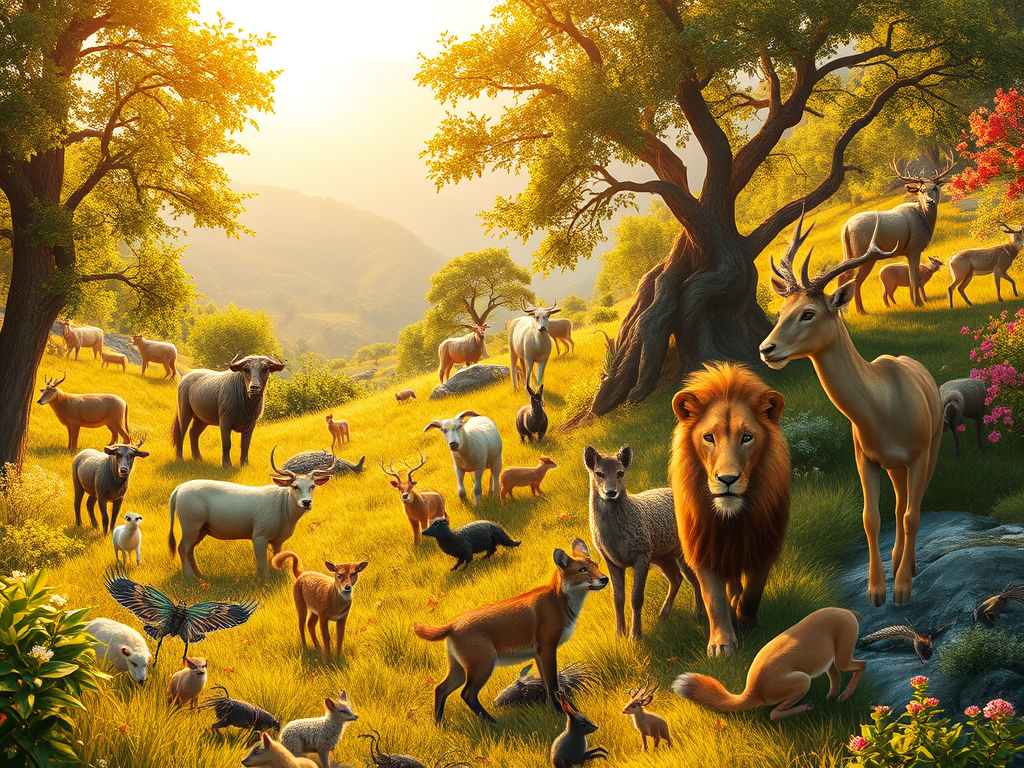
Life on Land: The Sixth Day Begins
And God said, “Let the land produce living creatures according to their kinds: the livestock, the creatures that move along the ground, and the wild animals, each according to its kind.” And it was so. God made the wild animals according to their kinds, the livestock according to their kinds, and all the creatures that move along the ground according to their kinds. And God saw that it was good.
(Genesis 1:24–25, NIV)
Summary
The sixth day of creation begins with the land producing animal life. Three major categories of animals are introduced: livestock, creeping things, and wild animals. Once again, the phrase “according to their kinds” is repeated—underscoring the theme of ordered diversity. As with previous days, God observes the result and declares it “good.” This sets the stage for the climactic creation of humankind, which follows in verses 26–31.
Historical & Cultural Background
Three Types of Land Animals
The categories listed would have been familiar to an ancient agrarian society:
- Livestock (behemah) – Domesticated animals used in farming and daily life: cattle, goats, sheep.
- Creeping things (remes) – Likely small ground-dwellers like rodents, insects, and reptiles.
- Wild animals (chayyat ha’aretz) – Undomesticated creatures like lions, foxes, and deer.
These categories reflect function and relationship to humans more than modern biological classifications. Domesticated animals represent economy and food; wild animals represent the untamed world; creeping things remind readers of what exists at the margins of visibility and power.
“Let the Land Produce”
Here, the land itself is invited to participate in the creative act—just as the sea “teemed” in Day 5. The language is poetic but also symbolic: creation is a collaborative system. In this worldview, land is not inert—it’s active, fruitful, and part of the divine ecosystem.
Hebrew Language & Word Notes
| Hebrew Term | Meaning | Significance |
|---|---|---|
| Behemah (בְּהֵמָה) | Livestock | Large domesticated animals. Linked to farming life. |
| Remes (רֶמֶשׂ) | Creeping/moving thing | Small, ground-based creatures, often low-status or hidden. |
| Chayyat ha’aretz (חַיַּת הָאָרֶץ) | Wild animals | Beasts of the field; not tamed, outside human control. |
| Leminayhem (לְמִינֵהֶם) | According to their kinds | Continues emphasis on structured variety. |
| Tov (טוֹב) | Good | Indicates divine approval; pattern of every completed act. |
Major Themes & Questions
1. A Structured and Diverse World
The repetition of “according to their kinds” signals deliberate variety within order. Genesis consistently emphasizes that creation is not chaotic but finely divided, classified, and intentional.
2. Human-Centric Categories
These three animal types mirror human experience: those we use (livestock), those that live apart from us (wild), and those that slip beneath notice (creeping). The text reflects a human perspective on nature, though it is not anthropocentric in the modern sense—humans haven’t been created yet.
3. The Goodness of Life Before Humanity
Before humans arrive, land animals are already named, blessed with diversity, and called “good.” This suggests a theological view in which non-human life has inherent value—not just utility.
Related Posts
- Genesis 1, Part 1: From Chaos to Cosmos (Genesis 1:1–13)
- Genesis 1 Part 2 1:14–19 — Lights in the Vault: The Fourth Day of Creation
- Genesis 1 Part 3 1:20–23
Further Reading
- John H. Walton, The Lost World of Genesis One
- Nahum Sarna, Genesis: JPS Torah Commentary
- Michael Heiser, The Unseen Realm
- Richard Middleton, The Liberating Image
- Mark S. Smith, The Priestly Vision of Genesis 1
Disclaimer & Call to Action
This blog reflects a scholarly, non-Christian reading of the Hebrew Bible. The goal is not to prove or disprove belief, but to look deeply at what these texts actually say—how they were heard by ancient audiences and what that means for us today.
Appreciating the depth of Genesis? Consider sharing this post, subscribing to the blog, or exploring the archive of other sacred text breakdowns at Sacred Scholar.

 Sacred Scholar
Leave a reply to Genesis Part 5 1:26–28 In the Image of God: – Sacred Scholar Cancel reply